|
We could get very technical about fertilizers, but we won't. If you follow the few simple rules below, you'll do just great. There are 11 points below ...but be sure to follow at least the first 4 and 10-11 for houseplants then lower down, soil lessons are below that
- Cheap fertilizer is not good and good fertilizer is not cheap
Usually it is best to buy the most expensive fertilizers (per pound of weight) that is available. Do not buy brands (cost more and may do no more). Buy contents so the most expensive bag of an unknown brand is likely better than the same price compared against a brand name product
Why? Because expensive fertilizers have more plant food value and less bulk (filler). Many better fertilizers are time released formulations that feed over 60+ days rather than washing away after 1, 2 or 3 rains
Now available, we offer Professional time release pellet food normally unavailable for retail. Click here for details
-
Fertilizer bags are labeled with contents such as 8-2-10 or some other set of 3 numbers. The 1st number is nitrogen content, the 2nd is the phosphorus content and the 3rd number is the potassium content. There are more essential foods (see below)
Do not think that a bag that says 20-20-20 is automatically 10 times better than a bag labeled 2-2-2. No plant wants or needs 20-20-20. You will want to get the right fertilizers for your plants
Fertilize your outdoor landscape plants often. Once a year (sorry to say) is stupid. Apply frequent small meals. Feeding 3, 4, even 6 times a year is way better, e.g. University of Florida recommends 6X a year
Apply granular fertilizer like salt and pepper. Sprinkle at and somewhat outside the drip line. Apply enough to clearly see the fertilizer on the soil but not much more. Apply a width depending on size of plant, e.g. a larger tree you might apply a 2-3 feet wide, small shrub, a few inches
The time to feed is when it is warm and hot. In South Florida, feeding #1 would be late winter, perhaps March 1st or so. Why feed then? Because that is when plants start their growth period. Feed often all the way to September or October in Florida zone 10. Last feeding is August or September zone 9. Last feeding in zone 8 would be August. If we get into a spell of ongoing heavy rains, consider the fertilizer washed away and re-apply to replace. Check your climate zone here
If you live in a cooler climate, follow the same rules. Feed right at the start of warm weather and quit about a month before cooler fall weather returns in your area
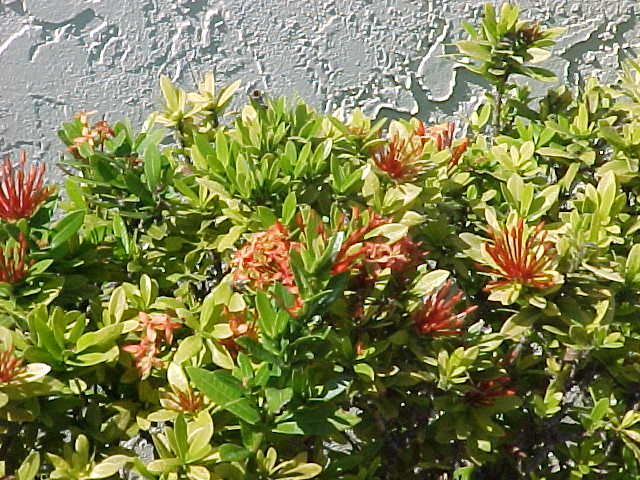
- Buy "acid forming" fertilizer for your Ixoras and Gardenias and all other acid (soil) loving plants. Read labels and find one that usually says "for acid loving plants" on the bag
If you have an Ixora hedge (and who doesn't?), you'll probably need to buy 2 or 3 bags. If you don't use proper fertilizer on Ixora, your plants will have very poor blooms and yellow foliage
- If you have citrus trees, you'll want to buy at least one bag of citrus fertilizer. Use palm food if citrus is not available
The latest recommendation for citrus is a bag labeled 8-3-9 or 8-2-10 and it should have at least 3% magnesium. See the back of the bag for other nutrients (minor elements) and their quantities. Minor elements are critical for citrus health. See our citrus article for more information
Citrus is not a tropical (as most people believe) but a Mediterranean plant. Unfertilized South Florida soils are terrible for citrus. For good fruit and healthy trees, buy citrus food
- The only remotely "universal" fertilizer type is a quality palm fertilizer
Palm fertilizer is now the about the only remaining fertilizer you can buy that reliably has "minor elements" in the mix. Minor elements include iron, zinc, manganese, magnesium, boron, etc..
In the past two years, even palm fertilizers have degraded in content. Read the labels for contents. Remember, cheap price = cheap contents (food value)
The latest University of Florida recommendation for palms is to use 8-4-12. Palm fertilizer should automatically include 3-4% of both magnesium and manganese
Critical:
Extra sensitive palms like Pygmy date palms, Sagos, Queen palms, Royal palm, Foxtail and Paurotis will probably die without these critical nutrients. To be 100% sure, go ahead and buy both magnesium and manganese as separate supplements to apply when you apply regular palm fertilizer
Be safe. READ THE BACK LABEL and get as many minor elements included as possible in your bag of fertilizer
You may end up with a bag labeled "Rose Food" or something else. Don't let these labels influence your purchase
The more different minor elements, the better
The more quantity of the minor elements, the better
The more usable minor elements, the better. For example, there's iron and there's chelated iron, which is far more available to the plant. Expect to pay more for the chelated iron content
Buy a bag with at least 6 minor elements. A bag with 8, 10 or 12 minor elements is even better
>>>>> The point is you can use good quality palm fertilizer on most everything in your landscape and be pretty safe you're doing the right thing
Follow label directions for quantity
If you want to be 100% sure you've done all the right things for your palms, also buy a manganese and a magnesium supplement (more bags). ALL PALMS (except native Florida palms) demand added magnesium and manganese for health. Follow label instructions. To add magnesium you will save money if you purchase Epsom Salts at your drug store. Epsom Salts is magnesium sulfate. Always apply at the same time with an application of your regular fertilizer for that plant (to prevent imbalance)
- In South Florida, plan on fertilizing at least 4 times a year from Spring through October. As of 1997, The University of Florida recommends 6 times a year is better, especially for palms. Fertilizers in Florida and other warm climate zones are ALWAYS applied ON TOP of the soil, never mixed into the soil, especially with potted plants. One reason is fertilizers are water soluable and release when in contact with water. Soils at the root zone are always wet, thus you would flood your roots with a continuous over dose of chemicals which will lead to plant stress, leaf drop and possibly death. Organic (non-chemical) nurtients (like worm castings) are always OK to mix into the soil
- For potted plants, you'll also want to buy some time released pellet food, a chemical fertilizer, and/or some organic fertilizer
Time released pellets are the best chemical time released fertilizer. There are now many brands of pellets so look for the contents - read the label. For example, most stores stock a lot of high nitrogen time release pellets. Formulations like 25-10-10 or any other 3 numbers with a high first number = a high nitrogen formulation. The ONLY time that would be correct is on foliage plants (nothing but leaves). For fruit and flowers, you want a low nitrogen formulation. Something like 5-10-10 or similar. What is usually easy to buy in pellets is a flat formulation like 14-14-14 (all numbers the same = flat formulation). We use a lot of flat formulation pellets and it works just fine in all potted plants
-
You can't burn plants with time release pellets. Buy your pellets at good nurseries, garden centers, Home Depot, Lowe's, etc.. You might see a brand such as DYNAMTE or OSMOCOTE or other barnds. Read the labels. Buy contents
- Another good supplement is IRONITE. Ironite really greens up plants (fast), but especially on plants which tend to yellow out. Use on trees is also very good, but may be harmful to palms and cycads. Try to find the dry, granular form of Ironite. Use a little per label instructions. Over use is a killer and iron is not a substitute for overall good fertilizer ingredients. Always use only on plants with wood (not fiber, like palms and cycads
- If you have bromeliads , orchids, staghorn ferns or other air plants, consider using Fish Emulsion fertilizer. There are also seaweed based organic fertilizers which are safe to use
Fish Emulsion is an organic fertilizer (ground up fish parts) and works wonders on all plants. You can use "fish" anywhere and everywhere, except maybe indoors. You won't like the smell, but Alaska brand we buy locally can be used for indoor plants as well. It's a sure thing as you can not burn or overdose using fish
We ignore the label which says 3-4 tablespoons per gallon every 3-4 weeks. Instead we 1-2 tablespoons per gallon and use it with every watering on potted plants. We also use Fish Emulsion fertilizer as a "tonic" for sick plants 2x or 3x strength over 2-3 waterings. You can also plant plants watering them into your soil with fish solution instead of plain water to promote quicker adaptation
There are also seaweed concoctions usually sold in highly concentrated formulations. We used to be able to buy ROOTS ORGANIC brand which was a marvel. ROOTS ORGANIC cured every sick plant we every tried it on and always used it in delicate transplants. A local exotic plants nursery TROPICAL PARADISE used to carry ROOTS ORGANIC, but the owner retired, sold out and his source was lost. If any reader knows where to buy ROOTS ORGANIC, we will be very pleased to receive your email
We can not recommend any specific seaweed supplement but all the ones we have tried have benefits. Some are used in the soil, others as a foliar spray, some both. Read the label
- Keep all your fertilizers dry and away from children and pets. You know why
- Use liquid fertilizers indoors if you must. Using time released pellet fertilizer is FAR better, but liquids are OK for occasional use. All (chemical) liquid is bad because most products contain large quantities of salts that will build up in your soil and on the surface of your pots (a white hard residue that doesn't wash off terra cotta pots easily)
We get tons of email from people who are killing their plants with liquid chemical fertilizers, especially Miracle Grow (it's heavily advertised so many people buy). We guess they believe the ads or use too much, but rapid decline is the common complaint
We can also say that plant professionals in South Florida do not use Miracle Grow. Almost all growers and nurserymen use Peters liquid, but NEVER as a main food. Almost all use time release pellets and an occasional boost using Peters liquid fertilizer (blends)
Lessons About Soil
Equally bad as using liquid chemical fertilizers improperly is using commercial potting soils that have fertilizers, hormones or other stuff INCLUDED into the bag. You would be shocked by the amount of email we get about soils that kill plants, e.g. "I re-potted my plant and almost immediately the plant started turning yellow, dropping leaves and looks really sick and dying." is super common in our email questions
For whatever the reason, the story is true. We can say that EVERY experiment we have tried using such soils with potted plants has lead to quick death. As you might expect, most "my plant is dying" emails specified Miracle Grow soil probably because Miracle Grow advertizes heavily and sells lots of bags. But other brands seem to be the same; that's what email says here
Must be too strong; too fast a release. Sadly, MOST store shelf space is now devoted to the soils injected with crystals of water soluable chemical fertilizers, so you have to shop even harder to find "clean" soil. You might consider mixing the chemically-injected soils with, say, plain Canadian peat moss or Perlite or coarse sand to dilute the chemical action ...we'd start with 50% dilution
In the wild, there is no fertilizer (added) and Nature's plants have being doing just fine for millions of years. Wild plants get 100% of their nutrition from the native soil. Nature's soil is a highly complex mix of decayed plants, decayed wood and fiber (palm parts), live and dead insects, worms, beetles, flies, bacteria, fungui, enzymes, hormones, etc.. Where people get into feeding problems is using non-native plants and using incompatible soils (compared to the actual native soil for each plant you want...which is impossible)
First, you must buy soils labeled "nursery mix" or "pro mix" or "Jungle Mix" or "Cactus Mix" or similar words and the bag must weigh very little for its size. ALL such soils are based on Canadian peat moss (sterile, clean). Side by side, a 40-lb. bag of "top soil" the bag of pro mix would probably weight 5 lbs or so. Also, you see 40-lb bags labeled "potting soil" which is the same super heavy stuff you don't want (except to blend into your sandy landscape soil). You can not use "potting soil" 100% straight for potted plants (way too thick/heavy)
Price is an excellent indicator just like price is an indicator of fertilizer quality. Junk, in 40-lb bags can cost as little as $1.49 per bag. Expect to pay $10-$16 for 2-3 cubic feet of quality soil. Some bags are labeled for size in "quarts" like 55 quarts. Very confusing because we think MILK comes in quarts. The soil you want to buy contains most or all of these contents:
-
Canadian peat moss
- Charcoal chips
- Wood chips
- Pinebark chips
- Seed hulls
- Composted manure
- Dehydrated manure
- Mushroom compost
- Perlite
- Vermiculite
A simple basic bag of proper soil contains Canadian peat moss plus Perlite and nothing else
The soil you buy SHOULD NOT CONTAIN:
- Top soil
- Potting soil
- Fertilizer
- Hormones
- Insecticide
- Fungicide
- Anything that came from a sewer plant
The more good ingredients the better. More is better because it's more complex, just like Nature's soils. However, know that these soils are sterile ...having no (natural soil) insects, no (natural soil) bacteria, no (beneficial) fungi, no (natural) enzymes, no (natural) hormones, etc.. That's why such soil is termed to be sterile. The benefits of sterile soil include 1. safe, 2. drains very fast
Such 'pro mix' soils are 100% used by professional plant people in Florida, usually purchased by the truck load from soil blenders, companies who supply the trade. You can call a good soil company in South Florida and specifiy EXACTLY what you want mixed and percentages. Soil is a major expense for growers. They know you can not grow good plants without good soil. Professional growers order what they need for what they grow
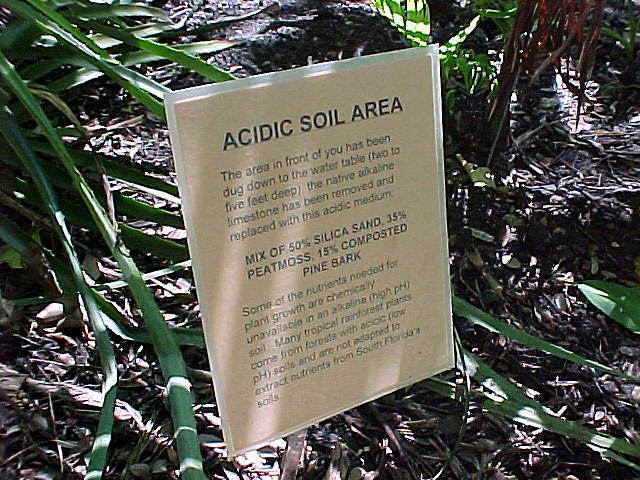
Here is an example - a sign we saw posted at Fairchild Tropical Gardens regarding th soil used
for an "acid loving" plant
click pic to enlarge
The sign says they mixed 50% silica sand, 35% peat moss and 15% composted pine bark into the existing soil. The sign also says they dug down 2-5 feet
We get asked "what brand" of good soil to buy. Brand does not matter. Few, if any, brands span the USA so local bags at your local stores is what you will consider by reading the labels and judging further with PRICE as an indicator
For potted plants, you can also blend your 'pro mix' with up to about 50% coarse sand (or Perlite). The reason is tropicals (like all houseplants) demand excellent drainage. The sand or Perlite helps a lot to loosen and aerate the soil for potted plants
|